

What is a Professional Stage Speaker System?
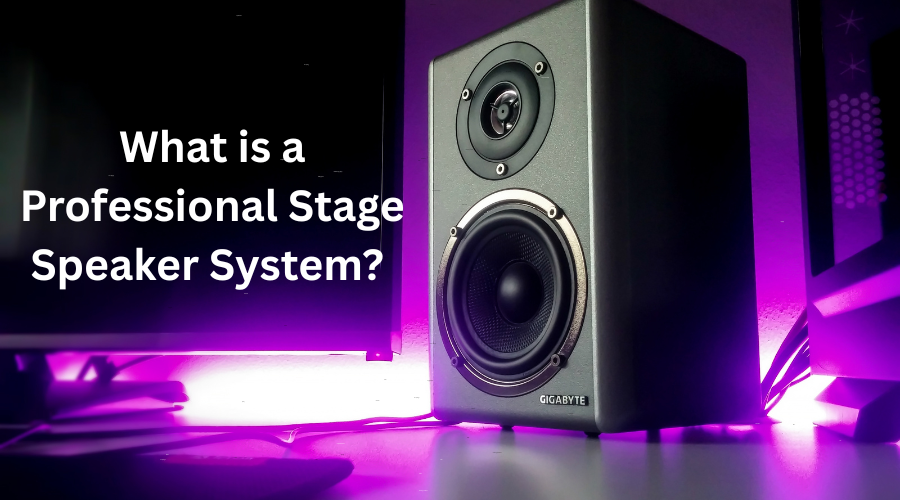
Speaker systems on stage power concerts, theater shows, and large events. They differ greatly from residential or consumer audio devices. This guide explains how to understand a professional stage speaker system and the components that make it up.
What is the Professional Stage Speaker System?
A professional stage speaker system provides loud, voice-enhancing performance over large, outdoor areas. In most cases, it includes a group of main speakers, subwoofers, monitor speakers, amplifiers, and signal-processing gear, all playing a coordinated role.
These systems are designed to operate continuously for long periods with high-volume playback, do not require professional handling for repeated shipments, and ensure accurate sound reproduction in large, often irregularly shaped, rooms.
Core Components of a Stage Speaker System
Main Front-of-House Speakers
Main speakers are front-of-house speakers aimed at the audience. These speakers are suitable for live performance, as well as for voiceover recordings and backing music. In bigger venues, the line array system consists of a set of stacked cabinets and controls sound dispersion, making it the system of choice.
Subwoofers
Subwoofers play low frequencies that the main speakers can't reproduce efficiently. Stage subwoofers are generally 15” to 18” drivers, and are stacked to add power and spread the bass around the floor of the venue.
Stage Monitors
Stage monitors are turned toward actors, not to the audience. These speakers are for musicians and singers to hear themselves at a concert. Wedge-style monitors rest on the stage floor at a slope, and in-ear monitor systems are another wireless option used more and more by touring professionals.
Amplification and Power Delivery
Powered vs. Passive Systems
A powered speaker has a built-in amplifier matched to its driver specifications. This facilitates the setup, and less equipment is required on site. Passive speakers need extra external amps, which provide flexibility to tailor power delivery across complex, extensive setups and support the engineer's hands-on experience.
Amplifier Power Ratings
Professional amplifiers for stage systems, in particular, can easily produce several thousand watts per channel across different setups and venues. Properly connecting the amplifier output to the speaker input prevents overpowering or underpowering of the speaker power amplifier due to distortion.
Signal Processing and System Control
Digital Signal Processors
DSPs, or digital signal processors, process the audio signal before it reaches the amplifiers. That includes equalization, crossovers, and speaker protection limits. DSPs support systems with many kinds and sizes of speakers, ensuring close adherence to sound quality.
System Tuning Software
Many manufacturers provide proprietary software to tune a system to the acoustics of a particular venue. This type of software often includes tools that analyze room response and provide guidance for tuning the processing to achieve the best results.
Speaker Enclosure Design for Live Sound
Line Array Cabinets
Line array cabinets are stacked vertically in cascades to join together as one. This design ensures vertical dispersion control and distributes sound evenly across the room's rows. For larger venues, you may need ten cabinets or more on a side to achieve the right coverage and volume.
Point Source Speakers
Point source speakers are used separately and don't form part of an array. These are intended for smaller auditoriums or fill speakers to supplement full line array speakers under the balcony, where full scale may not be necessary or practical.
Coverage and Dispersion Patterns
The speaker systems used on stage are designed to give a certain horizontal and vertical dispersion angle to control the sound. The size of the pattern used varies from 60 x 40 degrees to 100 x 15 degrees, depending on the cabinet design and the purpose of the cabinet.
The choice of dispersion patterns depends on venue size, shape, audience size, and mounting height. As a result of poor pattern matching, some portions of the audience might get too much Loudness while others get too little.
Rigging and Mounting Considerations
Flying Systems
Larger line array systems may hang on rigging above the stage, rather than standing on floors. This allows for good sound coverage and keeps speakers safely away from the stage and auditorium floor.
Ground-Stacked Systems
Ground-stacked systems are used for smaller audio systems or productions that go on a budget. These systems sit on speaker stands or subwoofer tops, making setup easier but not necessarily providing as much coverage as flown rigging.
Durability Requirements for Touring Equipment
Stage speaker systems are frequently loaded, transported, and set up at numerous locations throughout a tour. Reinforced cabinet corners, recessed handles, and tough casters or pole-mount cups help to support such heavy use.
When a buyer is searching for equipment for touring applications or equipment for rent, they should spec specifically for frequent transit, not occasional live use. This repeated handling causes weaker consumer-type construction to break faster.
Cabling and Connectivity
Speaker-Level Connections
Speakon connectors are used most often in professional stage systems for speaker-level connections, and feature a locking mechanism to prevent accidental pull-out during a show. This differs from the more basic connectors used in consumer audio gear.
Digital Audio Networking
Digital audio networking protocols like Dante or AVB are becoming more popular in larger systems to send audio signals to multiple speakers with accurate synchronization. This reduces cabling requirements throughout a large venue.
Choosing the right Size for the venue
Small Venue Systems
Generally, small clubs or conference rooms require small point source speakers and limited subwoofer support. Total system power in these applications is generally limited to a few thousand watts.
Large Venue and Arena Systems
If the venue is large, or a sports arena, the line array configuration needed to fill the space and provide uniform coverage and volume for a much larger audience would take a lot of space. These systems are typically composed of multiple individual cabinets and are controlled digitally in a centralized manner.
Renting vs. Buying Stage Speaker Systems
When Renting Makes Sense
For one-time shoots, smaller production companies with limited storage, or situations where a production is too big for a particular buyer. Rental also transfers the maintenance responsibilities to the rental company.
When Buying Makes Sense
Purchasing suits that are used on a recurring basis, booking acts that have regular requirements, or production companies that book regularly with rental fees likely to mount up over time.
Conclusion
A professional stage speaker system is an integrated system of main speakers, subwoofers, monitors, amplifiers and sound control designed for efficient large scale sound reinforcement. “Knowing these helps buyers match specs to the venue size and touring needs before they buy a system.
FAQS
What is a good place to find a professional stage speaker system online in bulk?
Any reliable supplier available on verified trade platforms, or a contact at an established pro-audio exporter.
How to select a stage speaker system supplier?
Get spec sheets, sample units, and certification documentation before entering into any wholesale bulk purchase order.
How to find a stage speaker system for a venue or production company?
Work with a manufacturer that provides main speaker outputs and monitor outputs to meet your comprehensive audio requirements.
What’s the difference between point source speakers and line array?
Line arrays are stacked to cover large venues and provide controlled coverage . Point source speakers are used independently in small venues .
Are there any special certification requirements for stage speaker systems to be shipped internationally?
Yes. Ensure CE, FCC, or RoHS compliance for your destination market prior to ordering.
Featured Articles
In KTV rooms, private party rooms, small bars, and wedding entertainme...
READ FULLA truly breathtaking live performance relies on a clear and stable sou...
READ FULLA subwoofer generates the lowest frequencies in the sound system. Corr...
READ FULL